

How to Choose a Reliable Flavor Supplier for Your Brand
- No Comments
If you manufacture food, beverages, or shisha molasses, your flavor supplier is one of the few decisions that touches everything else — product consistency, customer loyalty, and how fast you can bring a new SKU to market. A bad supplier relationship shows up months later as inconsistent batches or missed deadlines. A reliable flavor supplier becomes a seamless part of your production process, ensuring consistency, quality, and predictable results.
This guide walks through what actually matters when picking a flavor partner, the questions worth asking before you sign anything, and where Magic Flavours fits into that picture.
Need expert guidance before choosing a flavor partner?
Explore our Business Consultation services and discover how our experts can support your product development journey.
What Makes a Reliable Flavor Supplier?

Reliability isn’t a marketing word — it’s a checklist. A reliable flavor supplier gets you consistent quality batch after batch, ships on time, holds the certifications your market requires, and can put a technical person on the phone when something needs troubleshooting. Certifications like BRC or ISO aren’t just paperwork; they’re a signal that the supplier’s quality control process is real, not improvised.
Flavor Manufacturer vs Flavor Distributor: Which One Do You Need?
Not every “flavor supplier” does the same job, and knowing the difference saves you time.
Flavor manufacturers run their own R&D labs and build flavors from raw materials — this is where custom development happens. Distributors, on the other hand, buy in bulk from manufacturers and resell in smaller quantities, which works well if you need flexibility and don’t want to commit to large minimum orders.
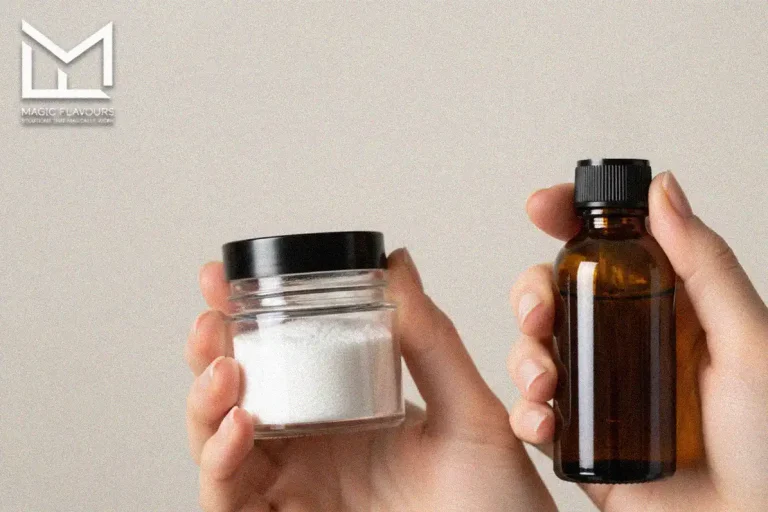
There’s also a split by application. Suppliers focused on food flavors usually work in powders, emulsions, and oil-based formats for baked goods or snacks. Suppliers focused on liquid or e-liquid flavors build water-soluble concentrates meant to dissolve cleanly into a drink, a shisha mix, or a vape base. If your product is liquid-based, working with someone who actually specializes in liquid formats — rather than a generalist — tends to save you a lot of reformulation headaches down the line.
What to Actually Check Before You Commit
Get clear on your own requirements first. Before you even reach out to a supplier, write down what you need: taste profile, strength, format (liquid, powder, extract), and any certifications that are non-negotiable for your market — organic, non-GMO, halal, kosher, allergen-free. Suppliers can’t hit a target you haven’t defined.
Look at their track record, not just their pitch. How long have they been operating? Who are their existing clients? A supplier that’s been serving the same industry for years has usually already worked through the problems a newer one hasn’t hit yet.
Test before you commit. Ask for samples and run them through your actual production process, not just a smell test. Small pilot batches tell you a lot about stability and how the flavor behaves at scale — and they cost far less than finding out after a full production run.
Ask what happens when you need something custom. Off-the-shelf flavors work for some products, but if you’re trying to differentiate, you’ll want a supplier with a real R&D team that can develop a profile around your brief and adjust it based on your feedback.
Confirm they can actually keep up with your volume. A supplier that’s perfect for a small batch order might not have the capacity for your peak season. Ask directly about lead times, and ask what their contingency plan looks like when something goes wrong upstream.
Don’t skip the compliance check. Ask for certifications, audit reports, and Certificates of Analysis up front. If a supplier is cagey about documentation, that tells you something.
Pay attention to how they communicate. This one’s easy to underrate. A supplier who flags a formulation change or a supply delay before it becomes your problem is worth far more than one who only responds when you chase them.
Based on experience working with manufacturers across different markets, the right flavor partner should provide more than a product — they should provide technical support and development expertise from the first sample onward.
Questions to Ask Before Partnering With a Flavor Supplier
- Do they send samples before you commit to a production order?
- Can their team develop a custom flavor from a brief, or only offer catalog options?
- What certifications do they hold, and can they provide documentation on request?
- What’s their typical lead time, and how do they handle urgent or seasonal orders?
- Do they support export markets, or are they set up for domestic supply only?
- Is there a minimum order quantity, and does it fit how you plan to scale?
How Does the Flavor Development Process Work?
For manufacturers who haven't gone through custom development before, the process usually looks something like this:
1. Understanding product requirements — the supplier gathers details on your product type, target market, and the taste direction you're after.
2. Flavor brief development — those requirements get translated into a working brief the R&D team can actually formulate against.
3. Sample creation — an initial sample (or a few variations) gets built for you to evaluate.
4. Testing and feedback — you test the sample in your own application and send back feedback; the profile gets adjusted accordingly.
5. Scale-up production — once the formulation is approved, it moves into full production at your required volume.
Knowing this upfront makes it easier to set realistic timelines and know what to expect at each stage.
Where to Find a Reliable Flavor Supplier
Trade directories and industry expos are still the most straightforward way to build a shortlist — you'll find both manufacturers and regional distributors there. LinkedIn and industry groups are also worth using; a referral from someone who's already worked with a supplier tends to be more useful than a cold search. From there, narrow your list based on your product category, your region, and whether you actually need manufacturer-level customization or just a reliable distributor relationship. Either way, working with a reliable flavor supplier that understands your product category makes the shortlisting process much easier.
Why Manufacturers Work With Magic Flavours
Magic Flavours supports manufacturers by combining flavor development expertise, application knowledge, and production-focused solutions:
- Custom shisha flavor development — an R&D team that builds profiles from a brief, not just from a catalog
- Food & beverage flavor solutions — formulations built for specific applications, not generic blends
- Export support — logistics and documentation set up for clients shipping across borders
- Sample development process — pilot batches before any full production commitment, so what you approve is what you scale
Consistency is treated as non-negotiable. Formulations go through testing before they ever reach a client's production line.
The regional footprint matters too. With a head office and R&D based in Istanbul and regional operations run out of Erbil, Magic Flavours brings hands-on experience across Middle Eastern markets — understanding regional preferences, regulatory expectations, and logistics in a way a distant supplier often doesn't.
For shisha flavor manufacturers, molasses producers, and food & beverage companies, that combination — hands-on R&D, tested consistency, and regional know-how — is what turns a supplier into an actual partner.
Frequently Asked Questions About Reliable Flavor Supplier
What should manufacturers look for in a reliable flavor supplier?
Look for consistent quality, valid certifications (like BRC or ISO), realistic lead times, and a team that can actually walk you through their testing process — not just a product catalog.
How do I choose between a flavor manufacturer and distributor?
If you need custom development or work at higher volume, a manufacturer usually makes more sense. If you need flexibility, smaller order quantities, or faster local delivery, a distributor may be the better fit.
Can a flavor supplier develop custom flavors?
Manufacturers with an in-house R&D team can. It's worth asking directly whether they build profiles from a brief or only offer existing catalog options.
What certifications should a flavor supplier provide?
At minimum, ask for food-safety certifications relevant to your market (such as ISO or BRC) along with Certificates of Analysis for the specific flavors you're sourcing.
Ready to Find the Right Flavor Partner?
Whether you're developing a new product or improving an existing one, our team is here to help.
Contact Magic Flavours today to discuss your project, request samples, or schedule a business consultation.
 English
 Arabic
 Turkish
 Persian