

A product can meet every spec on paper and still fail where it matters most: taste and aroma. A beverage picks up a papery note in storage, a flavored product gains a medicinal edge, or a fermented batch shows too much sulfur or a solvent-like note. These are off-flavors: unwanted taste or aroma characteristics that pull a product away from its intended profile.
Off-flavors rarely appear on their own — they point to a change somewhere in the system: a raw material, a process step, fermentation, packaging, or storage. The work starts after spotting the bad taste: finding out what changed, why it happened, and how to prevent it from happening again.
What Are Off-Flavors?
An off-flavor is an unwanted taste or aroma that falls outside a product’s intended profile. The word “off” does not mean a compound is inherently bad — many aroma compounds taste great at one level and terrible at another, depending on the matrix, other ingredients, and target profile.
A deviation becomes a true off-flavor when it does not match the approved profile, exceeds an acceptable intensity, or comes from an unwanted chemical, physical, microbial, or process change — a distinction that keeps teams from treating every unfamiliar note as a crisis, or ignoring a real one.
What Causes Off-Flavors to Develop?
Off-flavors rarely trace back to one ingredient or step — usually several factors interact before the problem becomes noticeable. Common mechanisms include oxidation, heat damage, microbial activity, fermentation imbalance, raw-material deterioration, ingredient interactions, poor sanitation, moisture, light exposure, packaging interactions, and unsuitable storage conditions.
Oxidation and Flavor Degradation
Oxidation is one of the most common causes of flavor deterioration — sensitive compounds react with oxygen during mixing, filling, packaging, or storage and turn stale, papery, or cardboard-like, especially with heat, light, or poor packaging. Protecting a formulation means controlling the whole system.
Thermal Processing and Flavor Changes
Heat drives many processes, but too much heat or too much time at temperature pushes a product toward cooked, burnt, caramelized, or degraded notes. The real question is whether temperature and time suit the whole formulation.
Microbial Activity and Contamination
Microbes produce compounds that change taste and aroma fast. Unwanted growth or contamination can bring on sour, phenolic, sulfurous, or musty notes — which is why sanitation, environmental control, and raw-material quality all matter.
Fermentation Imbalance
Fermentation adds complexity because the microbes are meant to be there — the goal is to keep activity in range, not eliminate it. Yeast health, nutrients, temperature, pitching, oxygen, and time shape the flavor; diacetyl, acetaldehyde, sulfur compounds, and esters can taste great at the right level and terrible outside it.
Raw-Material and Ingredient Issues
Some flavor problems start before production — raw materials vary with age, storage, supplier changes, oxidation, moisture, or spec shifts, and ingredients can interact unpredictably. Raw-material checks should cover sensory consistency and storage history.
Packaging and Storage
A product can taste perfect on day one and still develop an off-flavor in transit or on the shelf, since packaging controls oxygen ingress, light, moisture, and material interactions. Shelf-life testing needs to track sensory stability alongside microbiological and physical stability.
Common Off-Flavors and Flavor Defects
Sensory descriptors are a useful clue, not a final diagnosis — these deviations are often called flavor defects, since each marks a traceable break from the target profile.
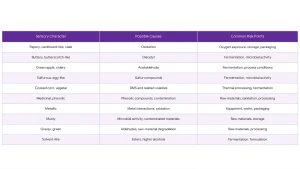
Sensory descriptors tell you what changed; root-cause analysis tells you why.
How Do You Identify an Off-Flavor?
A good investigation starts by replacing “the product tastes wrong” with a structured description. Use these steps.
Step 1 — Define the sensory character
What does it actually smell or taste like — papery, buttery, sulfurous, medicinal, metallic, musty, grassy, solvent-like, sour? A precise descriptor beats a vague complaint.
Step 2 — Compare it with the approved profile
Compare the affected sample against an approved reference to see exactly which attribute changed and by how much — this matters most when holding flavor consistency across production lots.
Step 3 — Determine when the change appeared
Was it there in the raw material, right after processing, during fermentation, or only after weeks of storage? Timing narrows the investigation fast.
Step 4 — Review raw materials and lot history
Check incoming materials for sensory deviations, age, storage history, lot variation, and supplier or spec changes — materials can carry defects and precursors that surface later.
Step 5 — Reconstruct the Production Process
Walk through the production chain in order — raw materials, formulation, processing, fermentation, sanitation — looking for the deviation that explains what the team is tasting.
Step 6 — Investigate packaging and storage
If the defect appears after production, check oxygen ingress, headspace, light, temperature, humidity, and packaging interactions.
Step 7 — Confirm the cause and validate the fix
Combine sensory evidence with process data: sensory descriptor → suspected mechanism → process location → corrective action → sensory confirmation — a chain that keeps the team from guessing through reformulation.
How to Prevent Off-Flavors
Prevention works better than correction, and it starts long before final inspection.
- Control raw materials: store to real stability needs and flag supplier or lot changes.
- Control temperature, time, pH, and oxygen: set variables per product and monitor consistently.
- Strengthen sanitation: treat it as prevention, not just a final cleaning step.
- Protect packaging and storage: shield the product from oxygen, light, temperature, and humidity.
- Monitor flavor quality: run routine sensory checks, not just at final release.
Can Off-Flavors Be Corrected Once They Appear?
Sometimes — it depends on the mechanism. Fermentation- or process-related deviations often improve with adjustment; advanced oxidation, contamination, or irreversible degradation usually cannot be reversed, and masking it with more flavor just adds a second problem.
Fixing the underlying cause beats masking it. Before changing the flavor system, confirm whether the flavor itself is causing the problem or simply revealing a deeper process issue.
When Do Flavor Problems Require R&D Investigation?
Routine checks can catch a deviation but not explain it — complex problems involving flavor compounds, raw materials, processing, packaging, and the product matrix often need deeper formulation and sensory work.
Process correction vs. flavor reformulation
A new flavor is not always the answer — sometimes the fix is oxygen control, thermal conditions, fermentation parameters, raw-material handling, sanitation, packaging, or storage; other times reformulation is necessary.
Rebuilding the target profile
When reformulation is right, the goal is to rebuild the full picture — aroma, taste, mouthfeel, aftertaste, balance — not bury the note under a stronger flavor. This is where flavor R&D matters: restoring the intended profile without unnecessary changes.
Validating the fix
A fix is not done until it is checked against the target profile — sensory comparison, process data, stability testing, or analytical work as relevant. The key question is whether the issue is resolved and the product consistently meets its target profile.
Frequently Asked Questions About Off-Flavors
What are the most common causes of off-flavors?
The most common causes include oxidation, heat damage, microbial activity, fermentation imbalance, raw-material deterioration, poor sanitation, packaging interactions, and unsuitable storage conditions.
How do you identify an off-flavor?
Define the descriptor, compare against an approved reference, pin down timing, then trace raw materials, processing, packaging, and storage for the likely cause.
What are common off-flavor examples in food and beverages?
Common examples: papery, buttery, sulfurous, medicinal, metallic, musty, grassy, and solvent-like notes. See the table above for causes.
Is every unusual flavor note an off-flavor?
No — a note is an off-flavor only when it does not fit the intended profile, exceeds acceptable intensity, or comes from an unwanted change.
Can an off-flavor be removed from a finished product?
Sometimes. Process-related defects often respond to correction; severe oxidation, contamination, or irreversible degradation usually cannot be reversed.
How do off-flavors affect flavor quality and consistency?
A subtle deviation weakens a product’s profile, and repeated issues become a formulation, process, or shelf-life problem too.
When should a manufacturer investigate an off-flavor?
As soon as a meaningful deviation appears — early action avoids a bigger production or shelf-life problem.
Conclusion

Off-flavors are rarely isolated events — they usually signal that something changed somewhere in the system. The strongest manufacturers do not stop at “how do we cover this taste?” They ask what changed, why it happened, and how to prevent it from happening again, connecting sensory evaluation with raw-material control, process monitoring, sanitation, packaging, and targeted flavor R&D.
If a sensory deviation is hard to explain, the Magic Flavours flavor R&D team can help — comparing your product against its target profile and rebuilding a stable flavor without unnecessary reformulation.
 English
 Arabic
 Turkish
 Persian