

Why Flavor Consistency Matters in Commercial Manufacturing
Flavor consistency is essential in commercial food and beverage manufacturing. A product may have an excellent formulation and strong market positioning, but if its aroma, taste, intensity, or aftertaste changes from one batch to another, the consumer experience becomes unpredictable.
Want to explore beverage flavors? Check out our solutions here!
Beverage Solutions
Achieving consistent flavor is more complex than simply reproducing the same recipe. Flavor performance depends on interactions between flavor compounds, raw materials, formulation, processing, storage, the food matrix, and human sensory perception. Research on aroma release shows that instrumental composition does not always directly predict sensory perception because matrix interactions, oral processing, and retronasal aroma release all influence what people experience. This challenge of maintaining batch-to-batch flavor consistency becomes even harder to manage as production moves from a small lab batch to full commercial volume.
This article covers two closely related areas: quality control during flavor manufacturing and the consistency of the resulting flavor system in the finished food or beverage.
The goal is not simply to reproduce a formula. It is to consistently deliver a defined sensory and functional profile within scientifically established acceptance limits.
What Does Flavor Consistency Actually Mean?
In industrial flavor manufacturing, consistency means reproducible sensory and functional performance.
A consistent product should maintain its intended:
- Aroma identity and intensity
- Taste profile and balance
- Flavor onset and persistence
- Mouthfeel interactions
- Aftertaste
- Key sensory characteristics
- Application performance
- Stability throughout its intended shelf life
Flavor should also be distinguished from aroma alone. It is a multidimensional sensory experience involving taste, retronasal olfaction, chemesthetic sensations, and interactions with other sensory inputs.
This is why analytical similarity does not always guarantee sensory equivalence. Two batches may contain similar levels of selected compounds but still produce different sensory impressions because odor thresholds, matrix interactions, aroma release, and human perception affect the final experience.
Proteins, lipids, carbohydrates, emulsifiers, hydrocolloids, pH, and temperature can all influence the retention, release, and perception of flavor compounds. Flavor should therefore be evaluated in its intended application, not only as an isolated ingredient.
Why Batch-to-Batch Flavor Consistency Is Difficult
Raw-Material Variability
Raw materials are one of the first potential sources of variation.
Natural ingredients can vary with geographical origin, season, maturity, processing conditions, moisture, acidity, and other compositional factors. Synthetic and nature-identical materials can also vary because of differences in purity, concentration, supplier, manufacturing process, storage, or analytical specification.
Effective flavor quality control therefore starts before production. Supplier qualification, clear raw-material specifications, incoming inspection, lot traceability, proper storage, and change-control procedures help reduce uncontrolled variation.
Formulation and Matrix Effects
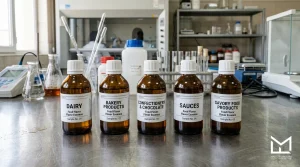
The same flavor may not perform identically in every product.
A flavor developed for a beverage may behave differently in dairy, bakery, confectionery, sauce, or savory applications. Flavor compounds can interact with proteins, lipids, carbohydrates, and hydrocolloids, changing their distribution, release, and sensory impact.
This is why professional flavor development requires application testing. Evaluating the flavor in the complete product provides information that may not be visible when testing the flavor concentrate alone.
Processing Conditions
Commercial manufacturing introduces another important source of variability.
Temperature, heating time, mixing intensity, shear, ingredient addition sequence, residence time, oxygen exposure, pressure, emulsification, and cooling conditions can all affect flavor performance.
Thermal processing may cause volatilization, degradation, oxidation, or chemical transformation of flavor compounds. Flavor stability therefore depends on both the chemistry of the flavor and the surrounding food matrix.
Mixing and emulsification also matter. Changes in mixing efficiency can affect flavor distribution, while differences in droplet size, phase distribution, or homogenization can influence release and sensory intensity.
Process control is therefore an essential part of maintaining a consistent flavor, not simply a general manufacturing concern.
Scale-Up: Why Laboratory Results Do Not Always Predict Commercial Performance
Moving from laboratory or pilot scale to industrial production is not simply a matter of multiplying ingredient quantities.
Equipment geometry, mixing dynamics, heat transfer, shear, mass transfer, oxygen exposure, and residence time can change with scale. A flavor system that performs well in the laboratory may therefore require additional application testing before commercial production.
This is where flavor robustness becomes important.
A robust flavor system maintains its intended sensory performance despite reasonable variation in the manufacturing process. The goal is not zero variability, which is unrealistic, but controlled variability that stays within defined sensory and analytical limits.
From Critical Inputs to Critical Flavor Quality
A useful way to manage flavor consistency is to identify which material and process variables have the greatest effect on final quality.
A practical framework is:
Critical Material Attributes (CMAs) → Critical Process Parameters (CPPs) → Critical Quality Attributes (CQAs) → Sensory Target
In this framework:
- CMAs are material characteristics that can influence flavor quality, such as purity, concentration, moisture, or acidity.
- CPPs are manufacturing parameters that can affect quality, such as temperature, mixing time, shear, addition sequence, or residence time.
- CQAs are measurable characteristics of the flavor system or finished product that must remain within an appropriate range.
- Sensory Target defines the final experience the manufacturer wants to reproduce.
Not every measurable variable is critical. Criticality should be supported by prior knowledge, manufacturing data, risk assessment, experimentation, or a combination of these.
For flavor manufacturing, this creates a more useful control strategy:
Material variability → Process variability → CQA variation → Sensory impact
That is stronger than simply testing the final batch after production.
What Actually Causes Batch-to-Batch Flavor Variation?

Flavor deviation rarely has one universal cause. A systematic investigation should consider the full manufacturing and application chain:
1.Raw-Material Drift
Changes in raw-material identity, purity, concentration, supplier, lot characteristics, or storage conditions can alter the final flavor profile.
2.Formulation Drift
Incorrect weighing, concentration differences, ingredient substitutions, addition-sequence changes, or formulation modifications can affect flavor intensity and balance.
3.Process Drift
Changes in temperature, mixing, shear, residence time, oxygen exposure, emulsification, or cooling can affect flavor distribution, release, and stability.
4.Analytical Drift
Sampling differences, instrument variation, calibration issues, analytical methods, or interpretation can create apparent differences or fail to identify meaningful ones.
5.Sensory Drift
Panel conditions, reference standards, sample preparation, assessor calibration, and sensory fatigue can influence results. Formal sensory-analysis standards therefore emphasize defined and controlled methodologies.
6.Storage Drift
Oxidation, volatilization, degradation, migration, and interactions with packaging or matrix components can change flavor performance over time.
This framework helps manufacturers identify the root cause of a deviation rather than simply increasing or decreasing flavor dosage.
Quality Assurance vs. Quality Control in Flavor Manufacturing
Quality assurance (QA) and quality control (QC) are related but distinct.
Quality Assurance focuses on the systems and processes designed to prevent defects and build quality into manufacturing.
Quality Control focuses on measurement, testing, inspection, and evaluation used to determine whether materials, processes, and products meet defined requirements.
In simple terms:
QA prevents uncontrolled variation.
QC detects, measures, and controls variation.
For example:
- Supplier qualification and change control are primarily QA activities.
- Raw-material testing is a QC activity.
- Process validation supports QA.
- In-process measurements are QC activities.
- Deviation management connects both.
A mature quality control in flavor manufacturing program should therefore operate within a broader quality-assurance system rather than function only as final product inspection.
Quality Control in Flavor Manufacturing: From Ingredients to Finished Product
A comprehensive control system can include:
Raw-material specification → Supplier qualification → Analytical verification → Formulation control → Process monitoring → Sensory evaluation → Finished-product assessment → Stability monitoring
Each stage addresses a different source of potential variation.
Analytical testing can verify chemical characteristics or marker compounds, while sensory evaluation determines whether a measured difference actually affects the product experience.
This distinction is important. Not every analytical difference represents a sensory failure, and not every sensory deviation can be explained by a single analytical measurement.
Analytical Testing and Sensory Evaluation Must Work Together
Instrumental analysis provides valuable information about flavor composition. Gas chromatography-based methods, for example, can help characterize volatile compounds and identify changes between batches.
However, a chromatographic profile is not a direct measure of sensory equivalence.
During consumption, temperature, chewing, saliva, matrix breakdown, and retronasal aroma release affect which compounds reach the olfactory system and at what concentration. Aroma release and sensory perception are dynamic and strongly influenced by the food matrix and oral processing.
Effective flavor quality control should therefore combine analytical testing with appropriate sensory evaluation.
Depending on the objective, sensory methods may include:
- Difference testing
- Descriptive analysis
- Intensity rating
- Similarity testing
- Temporal sensory methods
The appropriate method depends on whether the goal is to detect a difference, describe a profile, or determine whether a deviation exceeds a defined sensory specification.
A practical batch-control system can follow:
Reference standard → Analytical profile → Sensory assessment → Batch comparison → Deviation evaluation → Root-cause analysis → Corrective action
Flavor Fingerprinting and Specification Limits
Manufacturers can strengthen consistency by establishing a defined flavor fingerprint: a documented sensory and analytical profile representing the intended product target.
Instead of describing a product simply as “strawberry,” “vanilla,” or “orange,” the specification can define its relevant characteristics.
Depending on the application, a flavor fingerprint may include:
- Key aroma and flavor descriptors
- Relative intensity of critical attributes
- Taste balance
- Flavor onset and persistence
- Important analytical markers
- Relevant physicochemical parameters
- Application-specific performance
- Stability characteristics
- Sensory acceptance criteria
- Analytical specification limits
A target alone is not enough. Commercial quality control also requires defined tolerance and specification limits.
A practical system can distinguish between:
Target value → Specification range → Acceptance limit → Action limit → Out-of-specification condition
These limits should reflect the intended application and the degree of variation that produces a meaningful sensory or functional difference.
This helps avoid two common problems: rejecting harmless analytical variation with no sensory impact, or accepting measurable variation that changes the finished product experience.
Statistical Process Control: Detecting Drift Before Failure
For large-scale manufacturing, specification testing alone may not be enough.
A batch can remain within specification while the process gradually moves toward a failure condition. This is where Statistical Process Control (SPC) can be valuable.
SPC uses statistical methods and control charts to monitor process behavior, identify unusual variation, and detect trends before they become product defects.
A simplified sequence is:
Process data → Control limits → Trend detection → Drift detection → Investigation → Corrective action
For example, a manufacturer may monitor a critical process parameter such as mixing temperature or a validated analytical marker across successive batches. A single result within specification may not indicate a problem, but a sustained trend toward one side of the acceptable range can provide an earlier warning.
SPC should be distinguished from specification limits:
Specification limits describe what the product is allowed to be.
Control limits describe how the process is behaving.
A process can therefore become statistically unstable before the finished product becomes out of specification.
A Practical Manufacturing Control Framework
| Control Stage | Critical Variable | Control Method | Failure Signal | Action |
| Raw Material | Identity, purity, concentration | Analytical verification | Out-of-specification result | Quarantine / investigate |
| Raw Material | Supplier or lot variability | Supplier qualification and lot tracking | Unusual lot trend | Review / escalate |
| Formulation | Weighing and concentration | Batch record and verification | Dose deviation | Recheck / correct |
| Processing | Temperature, time, mixing, shear | In-process monitoring | Process drift | Adjust / investigate |
| Sensory | Key attributes and intensity | Trained sensory panel | Sensory deviation | Investigate |
| Finished Product | Flavor fingerprint | Analytical + sensory assessment | OOS or sensory failure | Deviation / CAPA |
| Storage | Stability and flavor retention | Stability monitoring | Flavor drift | Investigate / reformulate |
This model reflects a broader quality principle: quality should be built into the process rather than assessed only at the end.
What Should Manufacturers Expect From a Flavor Supplier?

A reliable flavor supplier should offer more than a flavor concentrate.
For commercial-scale manufacturers, supplier capabilities should ideally include:
- Consistent raw-material sourcing
- Defined manufacturing specifications
- Batch traceability
- Analytical quality control
- Sensory reference standards
- Application evaluation
- Scale-up support
- Flavor stability assessment
- Technical troubleshooting
- Change-control procedures
- Deviation-management procedures
The flavor supplier controls the flavor manufacturing system, while the food or beverage manufacturer controls the application and finished-product process. Consistency therefore depends on strong technical communication between both sides.
The best supplier relationship is a technical partnership, not simply a purchasing arrangement.
At Magic Flavours, this is exactly the role we aim to play for our manufacturing partners: consistent raw-material sourcing, batch traceability, application evaluation, and scale-up support, backed by a technical team that stays involved after the sample stage. If your production line is looking for a flavor supplier that can support commercial-scale consistency, we would welcome the conversation.
From Reactive Flavor Quality Control to Predictive Control
Traditional quality control is often reactive: a finished batch is tested, a deviation is identified, and corrective action follows.
A more advanced approach combines analytical chemistry, sensory data, process parameters, SPC, and statistical analysis to understand which conditions are associated with flavor variation.
Instead of asking only:
“Did this batch meet specification?”
Manufacturers can also ask:
“Which conditions are most likely to cause flavor deviation?”
This represents a shift from detecting inconsistency to designing for consistency.
A Practical Framework for Consistent Flavor
For manufacturers seeking more reliable flavor performance, the process can be summarized in eight stages:
- Define the sensory target
Establish what the finished product should taste and smell like. - Define critical quality attributes
Identify the sensory, analytical, and functional characteristics that must remain controlled. - Identify critical material attributes
Determine which raw-material characteristics have a demonstrated or credible relationship with the CQAs. - Identify critical process parameters
Determine which manufacturing parameters can materially influence flavor quality and establish appropriate operating ranges. - Establish specification and control limits
Keep product acceptance limits separate from statistical process-control limits. - Validate processing and scale-up
Confirm performance under realistic pilot and commercial conditions. - Combine analytical and sensory monitoring
Use instrumental measurements and appropriate sensory evaluation to assess batch consistency. - Investigate deviations systematically
Use SPC signals, analytical results, sensory data, and root-cause analysis to determine whether variation originated from raw materials, formulation, processing, analysis, sensory assessment, or storage.
Conclusion
True flavor consistency is not simply the ability to reproduce a formula on paper. It is the ability to reproduce a defined sensory and functional experience despite the natural variability of raw materials, formulation, processing, scale-up, storage, and human perception.
For manufacturers, achieving consistent flavor requires an integrated approach to flavor chemistry, application science, sensory evaluation, analytical testing, process engineering, specification management, statistical process control, and supplier collaboration.
The strongest flavor systems are not just those that perform well under ideal laboratory conditions. They are designed to remain robust, measurable, reproducible, and within defined acceptance limits under real commercial manufacturing conditions.
That is where effective flavor quality control becomes more than a testing function. It becomes an important part of product development, manufacturing efficiency, process capability, and long-term brand consistency.
Selected Evidence Base
- ISO 9000 / ISO quality-management terminology — distinction between quality assurance and quality control.
- ISO guidance on quality assurance and statistical process control.
- ISO 20613 — sensory analysis in quality control.
- ISO 4120:2021 — sensory triangle testing for perceptible difference/similarity.
- ISO 11132:2021 — performance of quantitative descriptive sensory panels.
- ICH Q8(R2) — risk-based linkage of material attributes and process parameters to CQAs.
- FDA Q8/Q9/Q10 implementation material — scientific rationale and risk management for identifying CQAs and CPPs.
- Chen et al. — review of flavor–food ingredient interactions and their sensory effects.
- Review of dynamic instrumental and sensory methods for aroma release and perception.
- Review of factors affecting ortho- and retro nasal flavor perception.
- Review of the reactivity and stability of selected flavor compounds.
- Review of recent developments in aroma release and perception during food oral processing.
 English
 Arabic
 Turkish
 Persian